Denver Real Estate Market Update: More Time, More Choice, Fewer Sales
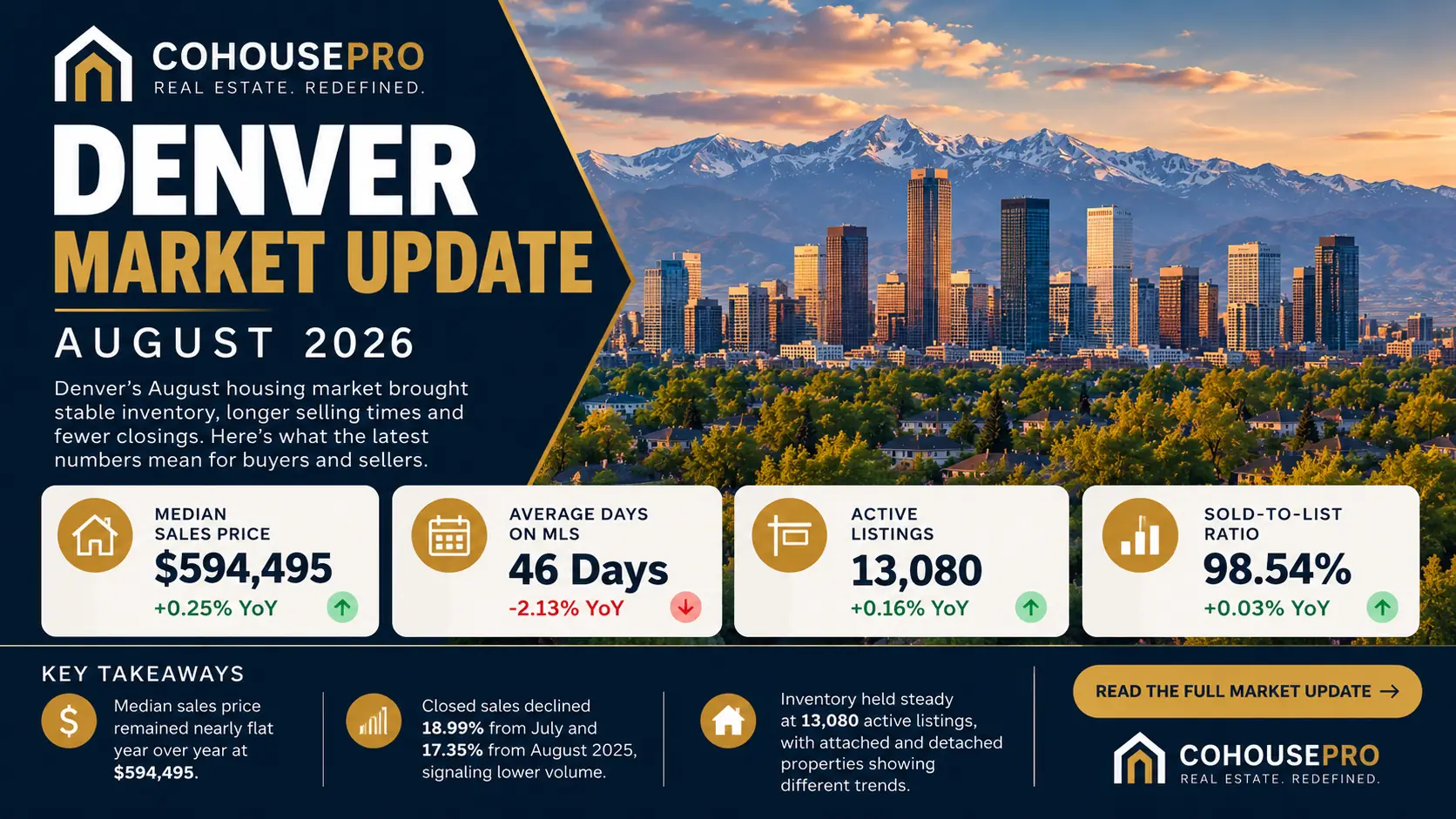
Denver's August housing market brought stable inventory, longer selling times and fewer closings. Here's what the latest numbers mean for buyers and sellers.
Market Snapshot
Denver Metro real estate delivered a mixed set of signals in August. Active inventory remained essentially unchanged at 13,080 homes, while closed sales fell sharply to 3,068. Prices remained comparatively stable, with the median sales price at $594,495, just 0.25% above August 2025. Homes also took longer to sell compared with July, with average Days in MLS increasing from 41 to 46. The result is a slower, increasingly property-specific market rather than a broad decline in values.
Median Sales Price
$594,495
+0.25% YoY
Active Listings
13,080
+0.16% YoY
Average Days on MLS
46 Days
-2.13% YoY
Sold-to-List Ratio
98.54%
+0.03% YoY
Fewer Transactions, But Stable Prices
The clearest change in August was transaction volume. Denver Metro recorded 3,068 closed sales, down 18.99% from July and 17.35% from August 2025. That is a meaningful slowdown, but it did not produce a corresponding drop in overall home values. The average sales price was $728,127, up 1.75% year over year, while the median sales price of $594,495 was 0.25% higher than last August. Fewer homes are changing hands, but slower activity is not the same thing as broad price instability.
Inventory Has Reached a Seasonal Plateau
August ended with 13,080 active listings across the Denver Metro market, down just 0.27% from July's 13,115 listings and 0.16% higher than August 2025. New listings declined 10.20% from July to 4,893. The source report notes that inventory appears to have reached a likely seasonal peak in July. The overall number also hides an important difference between property types: detached inventory declined 4.21% year over year, while attached inventory increased 9.94%.
Homes Are Taking Longer to Sell
Average Days in MLS increased from 41 days in July to 46 days in August, a 12.20% monthly increase. The median increased 28.57% to 27 days. The difference between detached and attached properties is especially important. Detached homes averaged 42 days on the market, while attached homes averaged 62 days. That additional market time gives many buyers more opportunity to compare properties, while increasing the importance of accurate pricing and presentation for sellers.
Pending Sales Offer a Positive Counterpoint
Pending sales were one of the few measures to improve month over month. Denver recorded 3,332 pending transactions, up 2.43% from July. Pending activity remained 7.52% below August 2025, so the market is still operating at lower volume than last year. However, the monthly increase may provide some support for upcoming closing activity and is an important indicator to watch as the market moves further into fall.
Attached and Detached Homes Are Telling Different Stories
One of the most important themes in the August numbers is the widening difference between attached and detached homes. Detached inventory declined 4.21% year over year, while attached inventory increased 9.94%. Attached homes also averaged 62 days in MLS compared with 42 days for detached properties. Pricing showed a similar divide. Detached average prices increased 1.70% year over year while the median was nearly flat, down 0.06%. Attached average prices declined 4.26% and attached median prices declined 4.87% year over year. These differences reinforce why buyers and sellers should evaluate the segment that applies to their specific property rather than relying solely on metro-wide averages.
Buyer Takeaway
For buyers, the current environment can create opportunities. Longer selling times mean some sellers may be more willing to negotiate, particularly when a property has been sitting on the market or is competing with several similar homes. Attached properties may offer additional room to compare options because that segment has more inventory year over year and longer marketing times. But buyers should not assume every listing is negotiable. A beautifully updated, appropriately priced home that checks nearly every box can still attract immediate interest. The better strategy is to evaluate each property individually by looking at Days in MLS, competing inventory, condition, price history and neighborhood-level activity.
Seller Takeaway
Buyers have become more selective, making accurate pricing, thoughtful preparation and strong presentation increasingly important. The source report notes that Denver Metro listings averaged approximately five showings during August. Sellers should evaluate their home against its direct competition rather than relying on broad market headlines. This is especially important for attached properties, where inventory is higher year over year and homes are taking longer to sell. Pricing and presentation should reflect what today's buyer can choose from right now, not simply what a nearby home sold for several months ago.
Preston's Denver Market Insight
The Denver market is becoming harder to describe with one headline, and that's exactly why local strategy matters right now. We had nearly the same number of homes available as we did a month earlier and a year earlier, yet closed transactions dropped significantly. At the same time, median pricing was essentially flat compared with last August. To me, that says this isn't simply a question of whether Denver is a buyer's market or a seller's market. The opportunity depends on the property. A well-priced detached home in a desirable neighborhood can behave very differently from an attached property competing against several similar listings. Neighborhood, price point, condition and property type matter more than the metro-wide headline.
— Preston Newberry, Denver Market Expert
"The next 30 to 90 days are likely to remain highly dependent on property type, neighborhood, affordability and seasonal inventory trends. New listings fell 10.20% from July while total inventory edged slightly lower, and the source report suggests inventory likely reached its seasonal peak in July. The 2.43% monthly increase in pending sales may provide some support for upcoming closings, although pending activity remains below last year's level. Elevated interest rates continue to present an affordability challenge. Rather than expecting one dramatic move across the entire Denver market, buyers and sellers should watch inventory, pending activity, financing conditions and pricing within their specific segment."
— Preston Newberry, Denver Market Expert
Key Takeaways
Market data sourced from DMAR (Denver Metro Association of Realtors) and Your Castle Real Estate Analysis for the 11-county Denver Metro area: Adams, Arapahoe, Boulder, Broomfield, Clear Creek, Denver, Douglas, Elbert, Gilpin, Jefferson and Park Counties. August 2026 statistics include single-family homes, condos and townhomes.
The CO House Pro Perspective
The August numbers reinforce something we talk about frequently at CohousePro: real estate decisions should be made at the property level, not from a headline. Metro Denver's median price was almost unchanged from a year ago, but that doesn't mean every homeowner experienced a flat market. Closed sales were down more than 17% annually, but that doesn't mean buyers have disappeared. Inventory was nearly unchanged overall, but detached inventory declined while attached inventory increased. If you're considering a move in Green Mountain, Lakewood, Golden, Morrison, Wheat Ridge or elsewhere across Denver Metro, the most useful question isn't whether the overall market is up or down. It's how your specific neighborhood, property type and price range are performing, and how you can use those conditions strategically.
What Does This Market Mean for Your Next Move?
Whether you're thinking about buying, selling, investing or simply wondering what your home could sell for today, metro-wide statistics only tell part of the story. Let's look at the numbers for your neighborhood, property type and goals.
Every market is different. Let's look at your specific situation and create a plan that works for right now.